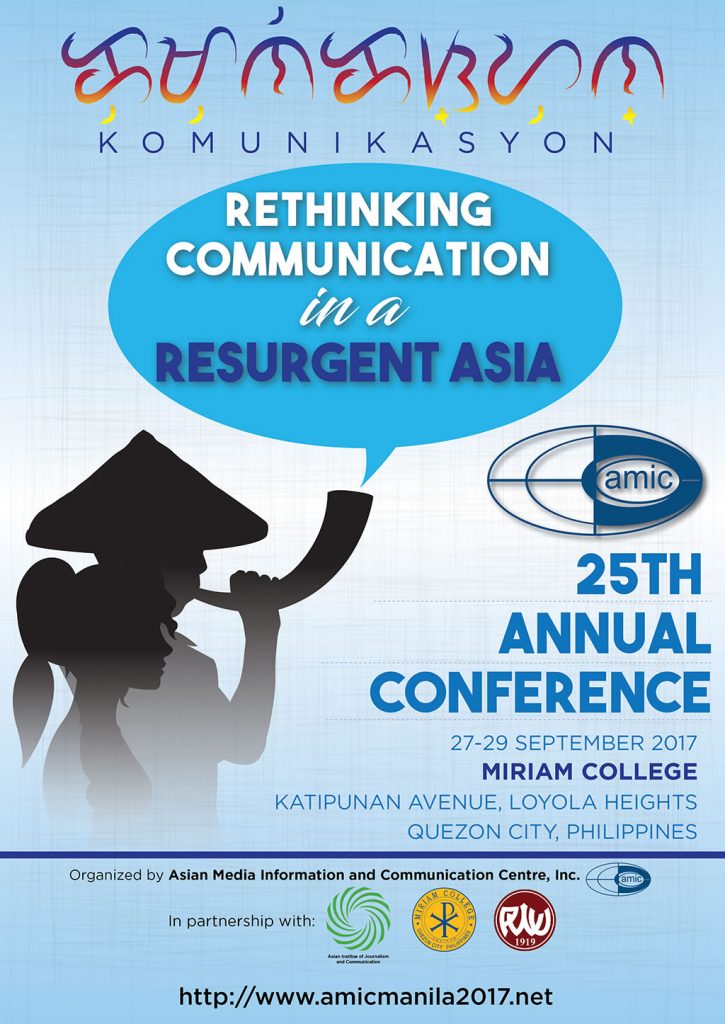

25TH Annual Conference
“RETHINKING COMMUNICATION IN A RESURGENT ASIA”
Miriam College 27-29 September 2017
MOOC : Pedagogy for Alternative and Life –long Learning for Sustainable Developmentunder Thailand 4.0
Kamolrat Intaratat, Piyachat Lomchavakarn
ABSTRACT
Since 2012, enrolments in Massive Open Online Courses (MOOC) have climbed to over 50 million registered users worldwide.50 million registered users worldwide. Also MOOC has concerned as the alternative education which response to the real demands of life especially among all the marginalized ones. This issue is concerned as the heart of the quality education as well as the SDG agenda endorsed by UN Member States in 2015 : SDG4-Education 2030 and the 2015 Qingdao Declaration to ensure access to quality education and unleash digital learning opportunities. MOOC can be the bridge between learning inside and outside classroom with its new approach to educate and empower their people at the same time.
 Nearly two decades, Thailand has been internationally recognized as a regional center for ICT growth and development, and its ICT Policy Framework has been an exemplary model for the development of an effective telecommunications and ICT regulatory environment. In 2014, with policy called “Smart Thailand 2020” was introduced and currently with its “Thailand 4.0” since 2016. The principal objective of the new plan is to boost accessibility, making ICTs a basic commodity for the entire country through ongoing improvements in infrastructure and increased mobile broadband penetration. The existing 2,500 telecentres scattered across the country as well as the coming 400,000 public Wi-Fi access points.
MOOC has been developing as well as developing its pedagogy as a tool for all marginalized groups both remote rural and urban poor communities. MOOC’s pedagogy for alternative education and Life –long learning has pilot with its highly demands academies such as Social Entrepreneurship; Communicative English; Start-up Community, Co-working Spaces, and others.
MOOC can offer responsive informal education for any marginalized ones with its sustainability development because of its : 1) Undertaken for the real needs; 2) Sensitive to the context and culture in which it is being applied; 3) Can make use of existing infrastructure, resources, facilities such as telecentre, WIFI kiosk all over the country; 4) Engage stakeholders in participatory processes; and 5) Use sound and simplified pedagogical and friendly administrative models.
1The Economist (14 Jan 2017). Established education providers vs new contenders
2UNESCO & Commonwealth of Learning (2016) Making sense of MOOCs : A Guide for Policy-Makers in Developing Countries
3Ministry of Digital for Economy and Society : Thailand 4.0
4The Research Centre of CCDKM, 2017 (https://www.ccdkm.org/)
Download Presentation : AMIC 27-29 September 2017

